
Doctor of Philosophy (PhD) in Palliative Care

Doctor of Philosophy (PhD) in Palliative Care

The online PhD in Palliative Care program at the University of Maryland, Baltimore (UMB) is the first and only Doctor of Philosophy in Palliative Care program in the United States. 

The PhD in Palliative Care program builds on the online Master of Science and Post-Baccalaureate Certificates in Palliative Care. The PhD in Palliative Care develops outstanding researchers in palliative care, while honing skills in leadership, education, and engagement in palliative care. 

The program requires the completion of 36 academic credits in addition to the 30 credits in the master's degree in palliative care, OR builds on a student's existing master's or other graduate degree (e.g., MD, PharmD, NP, DNP, PA, MSW, MDiv, etc.) in a relevant field with substantial and current experience in palliative care. 

Graduates will be well-equipped for positions in academia; leading tertiary care or palliative care centers; leading palliative care funding institutions and foundations; and working with accountable care organizations to identify patients who would benefit from palliative care. 
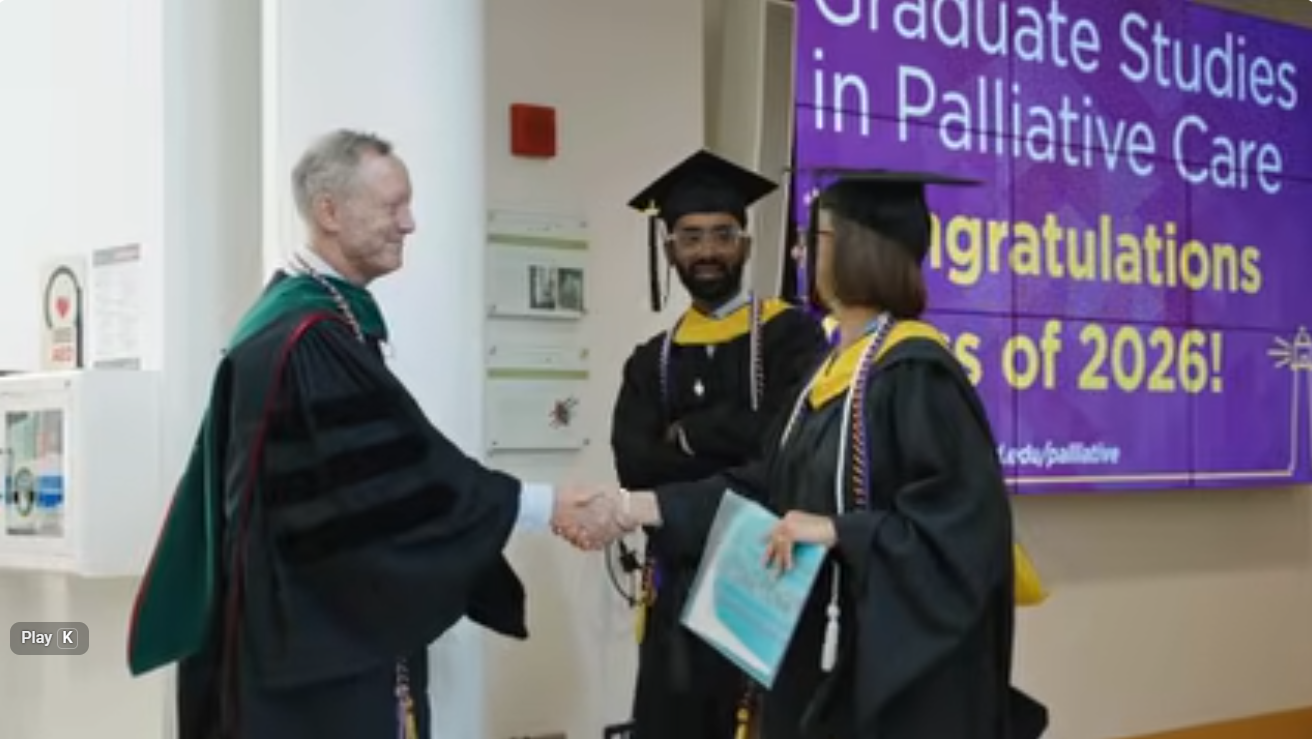
Applicants with experience in these areas are especially well-prepared to benefit from this interdisciplinary program: 

  • Physicians 
  • Pharmacists 
  • Nurses 
  • Physician Assistants 
  • Social Workers 
  • Administrators 
  • Researchers
  • Chaplains/Spiritual Care
  • Counselors 

Palliative care spans many fields, as professions address serious illness. 

About the Program

Applicants to the PhD in Palliative Care program should possess: 

  • Bachelor’s degree is required 
  • Master of Science in palliative care, OR 
  • Master's degree or higher (e.g., MD, PharmD, APRN, PA, MSN, MSW, MBA, MPH, etc.) plus palliative care experience
  • Current employment in palliative care preferred but not mandatory 
  • Three professional Letters of Recommendation 
  • Transcripts from ALL degree-granting institutions attended 
  • $75 non-refundable application fee 
  • CV  
  • Essay 
  • Other qualifications as determined by the admissions committee 
  • TOEFL/IELTS/Duolingo for international applicants  

Please see Course Descriptions for course details 

  • PALC 651 – Understanding the Foundation of Palliative Care: Building Blocks for the Future 
  • PALC 652 – Applied Biostatistics in Palliative Care 
  • PALC 661 – Quantitative Research in Palliative Care 
  • PALC 660 – Study Design and Critical Appraisal of Evidence (replaces PAL 618 in MS curriculum) 
  • PALC 662 – Qualitative Research in Palliative Care 
  • PALC 670 – Person-Centered Research in Palliative Care 
  • PALC 671 – Teaching Methods in Palliative Care 
  • PALC 672 – Leading Change in Palliative Care 
  • PALC 898 – Pre-Candidacy Research 

PALC 899 – Palliative Care Dissertation Research 

Our graduates are strategic leaders poised to promote a palliative vision, mission, values, beliefs, and goals for all patients. Their research advances knowledge in palliative care, creating an environment that fosters the development, adoption, and growth of interprofessional practice in palliative care. 

After completing this degree, the graduate will be able to:

1. Advance an evidence-based approach that integrates the origin and evolution of palliative care into future growth trends in the field. 

2. Utilize strategic leadership skills to promote a palliative vision, mission, values, beliefs, and goals from both a personal and organizational perspective. 

3. Integrate educational techniques and initiatives to improve and demonstrate sustainable educational programs and institutional effectiveness in palliative care. 

4. Advocate for professional and community engagement to expand equitable access and uptake of quality palliative care. 

5. Design, execute, and disseminate qualitative and/or quantitative research findings that advance the field of knowledge in palliative care. 

6. Create an environment that fosters the development, adoption, and growth of interprofessional practice in palliative care. 

Faculty will assess student achievement and mastery of learning. 

Next Steps

Your path to success starts here